
 Membership
 Network
 Regional Sites & Affiliates


 Events
 Participate
 Resources

 Training
 Credentials
 Government


 Publications
 Tools
Tools


 Business Overview




Facility management is entering a new phase of demand.
Across regions and sectors, facility professionals are seeing workloads increase — not because of a single disruption, but due to a combination of operational complexity, evolving workforce dynamics and cautious financial decision-making. To help make sense of these shifts, IFMA’s inaugural Facility Management Pulse Report offers a data-driven snapshot of how the FM landscape is changing worldwide.
Rather than signaling crisis, the data points to something more constructive: an opportunity for FM leaders to plan ahead with greater clarity.
Introducing the FMWI
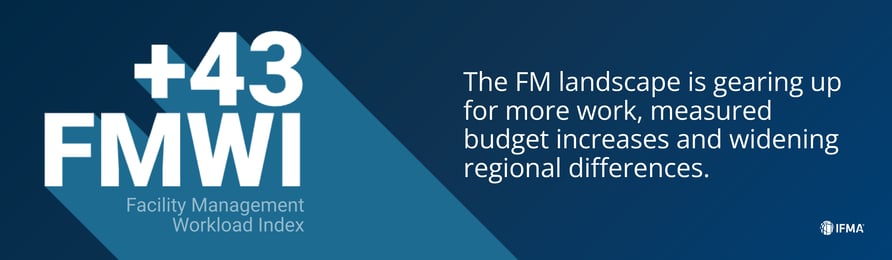
A central feature of the Pulse Report is the Facility Management Workload Index (FMWI), which is a new metric designed to track expected changes in FM workload over the next six months.
The index condenses global workload expectations into a single score ranging from –100 to +100. Scores above zero indicate that more respondents expect workload to increase than decrease.
The inaugural FMWI reading is +43, a clear signal that demand for facility management expertise is growing globally.
Importantly, the FMWI provides a consistent way to compare conditions across regions, sectors and future survey cycles, helping FM leaders understand not just what’s happening now, but how trends evolve over time.
What’s changing beneath the surface
Rising workload is only part of the story. The FM Pulse Report highlights several interconnected trends shaping how FM teams are responding.
1. Work is increasing, but capacity is being released carefully
While FM workload expectations are trending upward, organizations are approaching growth deliberately. Many teams are prioritizing sequencing, risk management, and resource alignment rather than rapid expansion.
This measured approach reflects a broader focus on sustainability — ensuring teams can meet demand without overextending people, budgets, or systems.
2. Budgets remain steady, but approvals are moving more cautiously
The data shows that budgets are largely stable, with modest increases in some areas. However, approval timelines are lengthening, signaling a more careful approach to releasing funds.
For FM leaders, this reinforces the importance of early planning, clear scope definition, and strong business cases that align operational needs with organizational priorities.
3. Hiring timelines are stretching, especially for critical roles
Staffing remains a key consideration. The average time to fill a critical FM role is now nearly four months, with longer timelines in some regions and sectors.
Rather than aggressive hiring, many organizations are focusing on targeted backfills, selective net growth, and strategic use of external partners to maintain coverage and flexibility.
While these trends are visible globally, how they show up in practice varies widely by region.
What FMs Are Seeing by Region
Overall, workloads are trending up, but the experience varies widely by region. Planning and execution are getting tougher, even where budgets are steady.
-
Latin America and Africa: Strongest workload growth. Teams are stretched and relying more on contractors. Early planning matters.
-
Asia-Pacific: Work is increasing, but budget pressure and system limitations are common challenges.
-
North America: Moderate growth. Staffing gaps and longer backfill timelines are the biggest pain points.
-
Europe: Slower growth overall. Hiring is focused on backfill, with more pressure on efficiency and system modernization.
Bottom line: Teams that are sequencing work early, locking in vendors sooner and tightening scope feel more in control than those reacting week to week.
What this means for FM leaders
Taken together, these trends point to a profession that is both in demand and increasingly strategic.
FM leaders are being asked to do more, but also to plan smarter. The FM Pulse Report data supports several practical takeaways:
-
Use workload signals early to prioritize projects and phase work realistically
-
Plan for longer hiring and approval timelines when setting expectations
-
Protect scope and sequencing to reduce downstream risk
-
Benchmark regionally and by sector to understand how your organization compares
The goal isn’t simply to keep up with demand, but to translate it into reliable, sustainable outcomes.
Understanding the Bigger Picture
Facility management continues to play a critical role in organizational resilience, performance, and experience. As workload increases, having access to clear, consistent data becomes even more important.
IFMA’s Facility Management Pulse Report is designed to provide that clarity — offering FM professionals a practical tool to track trends, compare conditions, and make informed decisions in a changing environment.
Download the free FM Pulse Report to explore the full data, regional insights, and what they mean for the months ahead by clicking the button below.


-1.png?width=352&name=Blog%20Post%20Images%20(6)-1.png)
.png?width=352&name=SFP%20Social%20Media%20Templates%20(1).png)