 Membership
 Network
 Regional Sites & Affiliates


 Events
 Participate
 Resources

 Training
 Credentials
 Government


 Publications
 Tools
Tools


 Business Overview




Facility managers are solving increasingly complex business challenges. They are managing operational continuity, reducing risk, supporting employee experience, navigating aging infrastructure and finding ways to do more with tighter budgets.
Yet many critical facility management initiatives still struggle to gain executive approval.
Not because the ideas are weak, but because the business case is.
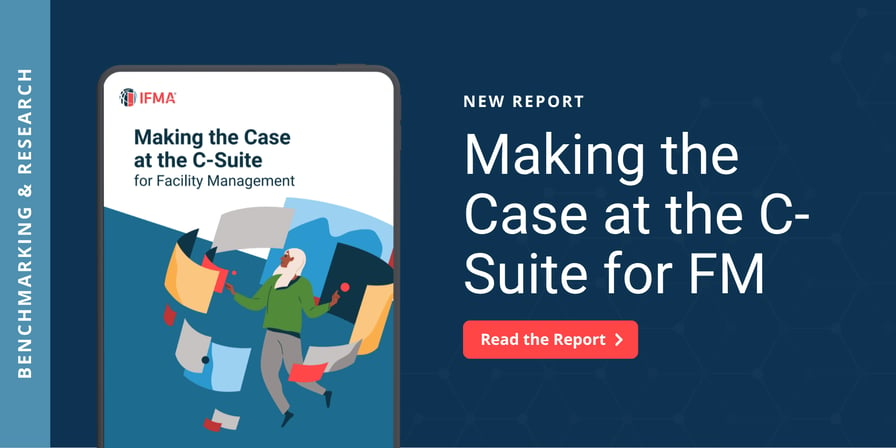
That challenge sits at the center of IFMA’s latest report, Making the Case at the C-Suite for Facility Management, which explores why many FM initiatives fail to secure leadership buy-in and what facility professionals can do differently to position their ideas as strategic business decisions rather than operational requests.
So why do so many important initiatives still stall?
The Real Challenge Isn’t Budget. It’s Executive Confidence.
Many FM teams believe they are competing for limited funding.
In reality, they are competing for executive confidence.
Senior leaders approve projects they can clearly evaluate, compare and defend. If a proposal lacks financial clarity, measurable business impact or a structured decision-making framework, hesitation follows, and hesitation often delays investment.
One of the report’s strongest takeaways is that executives are not looking for more operational detail. They are looking for decision-ready insight.
That means the strongest FM proposals are not framed around equipment, systems or maintenance tasks alone. They are framed around business outcomes.
Instead of:
“Replace the chiller.”
Leadership needs to hear:
“Reduce operational risk, improve energy performance and lower long-term operating costs.”
According to the report, this ability to translate technical needs into strategic business value is one of the defining differences between proposals that gain traction and proposals that stall.
Why Technically Strong Proposals Still Get Rejected
One of the biggest misconceptions in facility management is that a technically correct solution should naturally earn approval.
But executive teams are not evaluating technical accuracy alone.
They are evaluating:
- Business risk
- Financial return
- Organizational priorities
- Operational impact
- Speed to value
- Confidence in execution
According to the report, many FM business cases fail because they stop at the operational level instead of translating those operational realities into business language leadership already uses to make decisions.
Common breakdowns include:
- Failing to quantify the cost of inaction
- Presenting only one solution instead of multiple decision paths
- Weak financial comparisons
- Unclear accountability or implementation planning
- Risks that are identified but not actively managed
The Cost of Doing Nothing Is Often the Strongest Argument
Many FM proposals focus heavily on justifying investment.
Far fewer clearly quantify the cost of delay.
That distinction matters.
The report identifies this as one of the most important mindset shifts facility leaders can make. Instead of positioning projects as optional improvements, high-performing FM leaders frame them in terms of economic consequence and organizational risk.
- What happens if nothing changes?
- What does delay cost the business each month?
- What operational, financial or compliance exposure increases over time?
Because once leadership understands the cost of waiting, the conversation changes.
The initiative is no longer viewed as a discretionary expense. It becomes a business decision.
What High-Performing FM Leaders Are Doing Differently
The strongest facility leaders are not necessarily presenting better operational ideas. They are presenting those ideas differently.
They connect facility initiatives directly to enterprise priorities like risk reduction, operational continuity, employee experience and financial performance.
They quantify the cost of delay.
They anticipate executive objections before the meeting happens.
They structure proposals around decisions rather than requests.
And they present facility management as a driver of business performance rather than a support function operating in the background.
The report frames this evolution as part of a broader shift toward the “FM Analyst” mindset: professionals who can translate operational data into strategic business insight leadership can act on confidently.
The Bottom Line
Facility management has never been more important to organizational performance.
But importance alone does not secure executive approval.
According to IFMA’s Making the Case at the C-Suite for Facility Management report, the facility leaders gaining traction today are the ones who can clearly connect operational insight to business outcomes leadership already prioritizes.
That means moving beyond technical explanations and learning how to communicate value in terms of risk reduction, financial impact, operational continuity and long-term organizational performance.
Because in today’s environment, successful FM leaders are not just maintaining buildings.
They are influencing strategic business decisions.
Ready to strengthen your business case?
Download IFMA’s Making the Case at the C-Suite for Facility Management report to explore the 5Ps framework, financial modeling guidance, procurement strategies and decision-making tools designed to help facility professionals secure executive buy-in and position FM as a strategic business driver.