
 Membership
 Network
 Regional Sites & Affiliates


 Events
 Participate
 Resources

 Training
 Credentials
 Government


 Publications
 Tools


 Business Overview




At 2 a.m., a mostly empty office building should be sipping water, not drinking it. The cleaning crew finished hours ago and the kitchens are dark, so the meter ought to be close to its floor. When it keeps turning anyway, something is running that nobody scheduled. With the UN's latest World Water Development Report describing rising freshwater stress across regions, an unexplained overnight flow isn't just a maintenance curiosity; it's money and water leaving quietly. The 2 a.m. reading is useful because many buildings hit a predictable low point then, not because the clock itself proves anything.
Here's how to turn that quiet window into an audit that actually ends in a repair.
First, prove 2 a.m. is actually quiet
The audit starts with the operating schedule, because an overnight reading means nothing until you know which legitimate loads should still be running. Plenty of water use after midnight is entirely defensible. Irrigation controllers often run at night on purpose. Cooling towers keep making up water in warm weather, and humidification draws during dry seasons. Storage tanks tend to refill when demand is low, which is exactly the window you're watching. A hotel laundry or hospital sterilizer doesn't care what time it is, and neither does process equipment on a night shift.
So before calling anything waste, list what should be on during your chosen window, and pick the window honestly. For a school, 2 a.m. might be dead quiet; for an airport, it might be the wrong question entirely. Compare a representative weekday against a weekend or shutdown night, and note anything seasonal. The point isn't to find a silent building. It's to know what quiet looks like for yours.

Build a baseline before setting an alarm
A useful alarm compares the building with its own normal low-occupancy pattern, not with a number borrowed from another facility. If you have interval data from a smart or advanced meter, the U.S. EPA's guide to metered data for facility managers shows what to look for: a continuous floor that never drops where it should, or a step change that appeared on a specific date. Events repeating at odd hours count too. Hourly data is often enough to spot the pattern; shorter intervals mainly help you isolate it later.
No interval data? The manual version still works, and real-time facility monitoring can come later. Record the meter when the known loads are off. Wait a defined stretch of the quiet window, then read it again. Movement you can't attribute is your anomaly. Resist the urge to adopt someone else's threshold; a few comparable nights of your own data will tell you what normal variation looks like better than any borrowed rule.
Trace the flow without metering everything
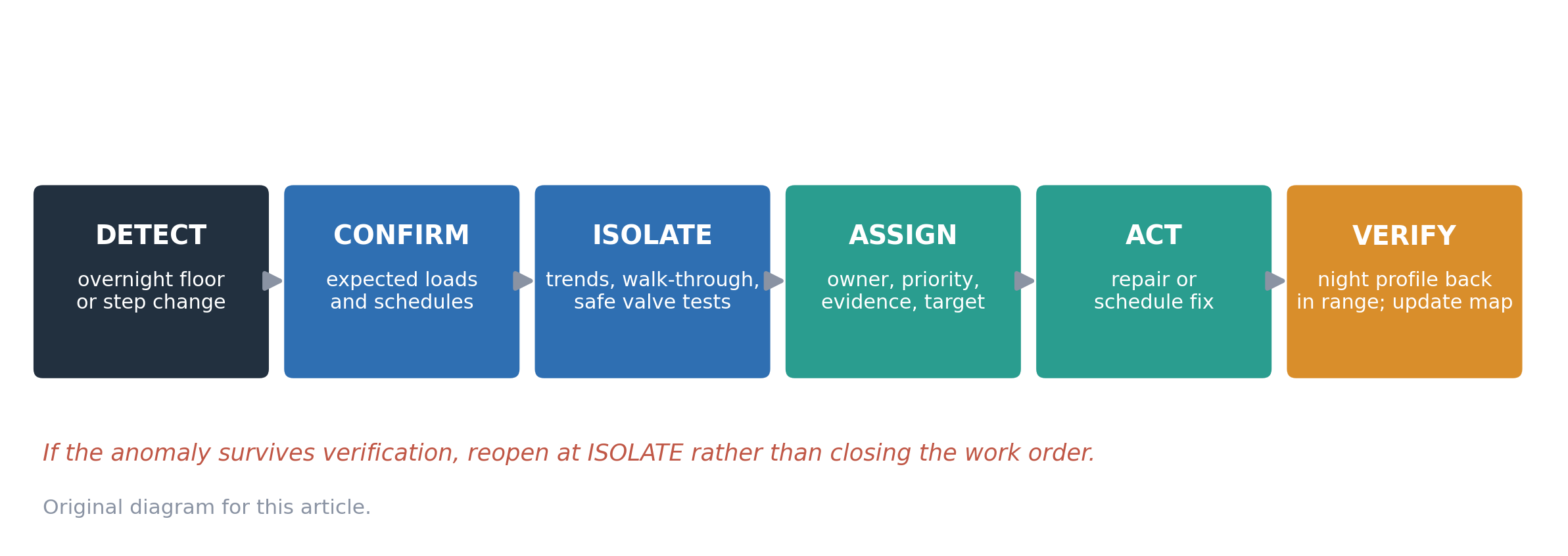
Start with the schedules and meters you already have, and add measurement only where recurring uncertainty justifies it. Check the anomaly against irrigation, cooling, cleaning and production calendars first, because the cheapest diagnosis is a schedule someone changed without telling facilities. Then pull whatever your existing submeters or building management system trends show and walk the likely areas. Where your procedures allow, run authorized isolation tests, closing one branch at a time until the flow reacts.
Permanent submetering earns its cost in specific situations: a large or critical end use such as a cooling tower or commercial kitchen, a zone where ambiguity keeps returning, tenant or departmental accountability, or verification of a conservation project. The EPA's metering and submetering guidance is a solid reference on where meters pay off, with one caveat worth repeating: sizing matters, because an oversized meter can miss exactly the low flows this audit cares about. For a one-off investigation, temporary diagnostic metering may answer the question without a capital request.
Make the anomaly somebody's work
An unexplained overnight flow becomes useful only when it turns into an owned, evidence-backed task; a dashboard nobody acts on is just decoration with a login. The handoff needs the timestamp and trend, the loads you've already ruled out, the suspected zone or end use, the consequence of ignoring it, a priority, a named owner, and a response target. Something like: "Continuous overnight flow above this site's normal range; verify scheduled loads, inspect the irrigation and cooling branches, record findings, and attach the post-action overnight trend."
Site-specific alert levels keep the notifications rare enough to be taken seriously, and the routing deserves as much design as the detection. IFMA's FMJ has a useful discussion of who sees and acts on the alert that applies directly here, and if the flow turns out to be a burst rather than a slow bleed, that's when a plan to standardize the response after a water event takes over from the audit.
The audit is finished when the night profile changes
Closing the work order isn't the finish line; the overnight profile returning to its expected range is. After the repair or schedule fix, compare a night under the same conditions you used for the baseline. If the anomaly is still there, reopen the investigation, because activity without verification is how the same leak gets "fixed" three times. Then record the cause and update your expected-load map, tuning the alert so the next deviation stands out sooner. The dashboard worth keeping isn't the prettiest one. It's the one that helped your team explain the anomaly and then prove, with a named owner in between, that the building's nights actually changed.
About the author: Fabian Sandoval is a writer covering facility operations, workplace technology and the people who keep buildings running. His work appears on IFMA's Connected FM blog and Jobillico, where he focuses on what new tools actually change for the teams expected to use them.